
How can we have more people of colour in leadership positions?
In our community and our churches, we are called to recognise the dignity of every person as a child of God. Yet, when we look at the leadership of our British institutions—from university boards to the senior civil service—it is clear that many are still being left behind. As we strive for a society that reflects the diversity of God’s creation, we must ask why so few people from ethnic minority backgrounds reach the “upper rooms” of leadership. This isn’t simply a matter of waiting for time to pass; it is a structural challenge that requires us to act with intention and heart.
Before we can fix the problem, we must understand the invisible hurdles that prevent talented individuals from progressing. One of the most common barriers is what we call the “Pedigree Trap”. This happens when we naturally lean towards people who mirror our own social and educational backgrounds.
Furthermore, we must recognise the educational gap that often starts early in life. Candidates from minority backgrounds are statistically more likely to face a “double disadvantage” involving both race and socio-economic hardship. This makes the road to elite education much steeper, and without the right support, many gifted individuals find their path blocked before they even begin their careers (Social Mobility Commission, 2024).
Another vital distinction to make is the difference between mentoring and sponsorship. While many leaders are happy to offer advice and a cup of coffee to junior staff, true justice requires “sponsorship”. A mentor talks to you, but a sponsor talks about you in rooms where promotions are decided and where you are not present (Ibarra, 2019). Research shows that even with identical qualifications, ethnic minority graduates from state schools are over 30% less likely to be hired by top firms than their white peers (UCL, 2025).
To build a more inclusive future, our organisations must move beyond words and adopt a strategy that covers recruitment, retention, and promotion. For recruitment, we should implement “Contextual Hiring”. This means looking at a candidate’s achievements in light of their environment. An ‘A’ grade achieved at a struggling school often speaks of greater perseverance and spirit than one achieved in a privileged setting.
When it comes to keeping staff, we must ensure they feel they truly belong. One effective method is “Reverse Mentoring,” where senior executives spend time being “mentored” by junior staff from different backgrounds. This helps those at the top understand the daily reality of the institution and the subtle barriers their staff face. Finally, for promotion, we must follow the lead of the Parker Review 2026, which urges every senior role to have a succession plan that identifies and prepares at least one qualified ethnic minority candidate.
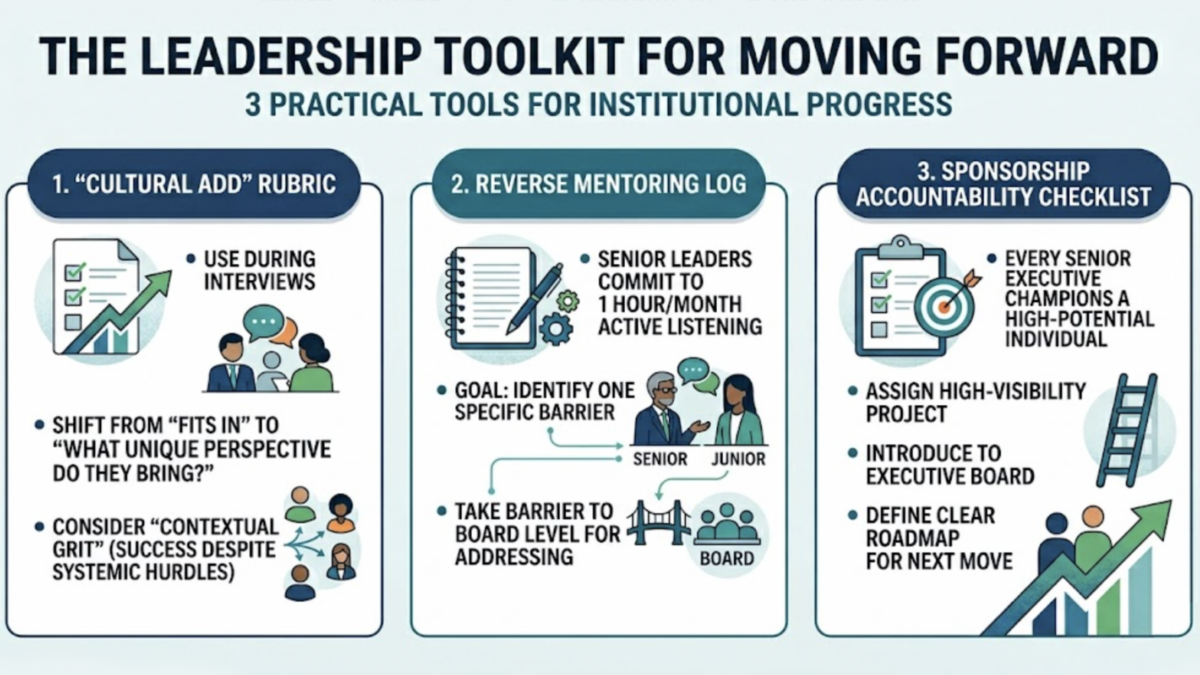
The Leadership Toolkit for Moving Forward
 To help your institution begin this work today, we have developed a practical toolkit. First, use a “Cultural Add” Rubric during interviews. Instead of asking if someone “fits in,” ask what unique cultural or community perspective they bring that you currently lack. Consider if they have the “contextual grit” to have succeeded despite systemic hurdles.
Second, maintain a Reverse Mentoring Log. Senior leaders should commit to one hour per month of active listening with a junior staff member. The goal here is to identify one specific barrier mentioned by the staff member and take it to the board level to be addressed.
Third, use a Sponsorship Accountability Checklist. Every senior executive should identify a high-potential individual they will actively champion. This involves assigning them a high-visibility project to showcase their talent and introducing them to the Executive Board. By defining a clear roadmap for their next move, you ensure their progress is managed with care.
By opening these doors, we do more than just improve a business; we honour the spirit of justice and ensure that every person has the opportunity to serve at their highest potential.
Reference List
- Ibarra, H. (2019). ‘A Lack of Sponsorship Is Keeping Women and Minorities from the C-Suite’, Harvard Business Review.
- McGregor-Smith, R. (2017). Race in the workplace: The McGregor-Smith Review. London: Department for Business, Energy & Industrial Strategy.
- Social Mobility Commission (2024). State of the Nation: Social Mobility in Great Britain. London: Social Mobility Commission.
- The Parker Review Committee (2026). Improving the Ethnic Diversity of UK Boards: 2026 Update. London: The Parker Review Committee.
- UCL (2025). ‘UCL News: Ethnic minority and working-class graduates face barriers to top UK jobs,’ UCL News.